Corten Steel Garden Edging: The Complete Australian Buyer’s Guide

Corten steel garden edging is weathering steel that forms a warm, rust-coloured surface on purpose, and that surface is exactly why people choose it. It gives garden beds a natural, earthy border that suits Australian gardens, and once it settles in it needs almost no looking after. If you are weighing it up for your own garden, this guide walks through the sizes, the two ranges we stock, what it costs, how much you need, and how to install it.
We have kept the focus on the buying decision here. If you first want to understand how corten compares to a galvanised finish, start with our guide on how to choose between corten and galvanised garden edging, then come back here to work out the right product and quantity.
Key points
- Corten is weathering steel that forms a protective rust patina, so it does not need painting or coating
- We stock the premium in-house Landscape Edge Cor-Ten range, in 2.0 mm gauge for straight runs and curves
- Heights run from 100 mm to 200 mm, with a rigid 2.0 mm gauge
- Corten garden edging starts from $29 and ships Australia-wide from our Melbourne warehouse
- It interlocks and hand-bends for curves, so most gardeners install it themselves
What makes corten steel edging different
Corten steel edging is made from weathering steel, a group of steel alloys built to rust on the surface and then stop. When ordinary steel rusts, the corrosion keeps eating into the metal until it flakes away. Weathering steel does the opposite. It forms a tight, stable rust layer called a patina that seals the surface and slows further corrosion right down (Wikipedia).
The reason it behaves this way comes down to the alloy mix. Copper is the most important ingredient, and it helps the surface form a protective layer instead of flaking off like normal rust (Wikipedia). That protective layer even regenerates over time, so a light scratch weathers over rather than turning into a rust spot (Total Materia).
For a garden, that means two things. You get the rich orange-brown look that blends with timber, gravel, stone and native planting, and you get a border that holds up outdoors for years with no painting, sealing or upkeep.
How the patina forms
The patina needs cycles of wetting and drying to develop, which is why it settles in naturally outdoors (Wikipedia). Fresh weathering steel starts out closer to bare grey steel, then shifts to a bright orange before deepening to a darker brown as it matures. Under normal conditions the patina takes roughly 18 to 36 months to fully develop, and it forms faster in wetter, more exposed spots than in dry, sheltered ones (Total Materia). One thing to note for coastal gardeners: salt air slows the patina down, so seaside gardens can take longer to reach that settled finish (Total Materia).
To save the wait, both of our corten ranges come pre-rusted from our warehouse, so they already have that weathered look when they arrive rather than starting out grey.
Corten garden edging sizes and gauge explained
Picking the right size is the part most people get stuck on, so here is the plain version.
Height is how deep the edge sits, measured top to bottom. Our corten edging comes in 100 mm, 125 mm and 200 mm. Taller edging gives a stronger underground barrier and a bolder line above ground, while shorter heights suit low borders and tidy lawn edges.
Gauge is the thickness of the steel. Thinner gauge bends more easily for curves, and thicker gauge holds a straighter, firmer line. Our Landscape Edge Cor-Ten is a rigid 2.0 mm gauge, which holds a firm straight line while still bending easily by hand for curves.
Length matters for working out quantity. Each piece is designed to overlap the next so the join sits flush, which means the usable length is a little less than the full length. On our Landscape Edge Cor-Ten, each 1100 mm piece gives you 1 metre of usable edging after a 100 mm overlap.
If your main goal is stopping grass runners creeping into the beds, aim to bury 30 to 40 mm of the edge below the surface. For more on that, our guide on how steel garden edging prevents grass runners covers it in detail.
About the Landscape Edge Cor-Ten Range
Our Landscape Edge Cor-Ten range covers the corten sizes most Australian gardeners need.
Our Landscape Edge Cor-Ten is our premium in-house range. It runs a heavier 2.0 mm gauge with integrated 100 mm spikes, which makes it the sturdier choice for straight runs, larger jobs and firmer ground. It comes in 100 mm, 125 mm and 200 mm heights, so it is the one to reach for if you want that deeper 200 mm barrier.
| Feature | Landscape Edge Cor-Ten |
|---|---|
| Gauge (thickness) | 2.0 mm |
| Heights | 100, 125, 200 mm |
| Spikes | 4 x 100 mm integrated |
| Best for | Straight runs, curves, larger jobs and deeper barriers |
| Price from | $29 |
Landscape Edge Cor-Ten is made from genuine corten steel and arrives pre-rusted, so you get the warm patina from day one and a firm, long-lasting edge in every height.
How much corten edging do you need, and what it costs
Start by measuring the total length of every edge you want to line, in metres. Add the sections together for your total run.
Then allow for the overlap between pieces. With our Landscape Edge Cor-Ten, a 1100 mm piece gives 1 metre usable, so your total run in metres is roughly the number of pieces you need.
For garden rings and curved beds, measure the circumference of the area you want to enclose, then pick the ring size that matches.
Corten garden edging starts from $29, and your total mostly comes down to how many metres you need and which range you choose. Corten usually sits a little above the galvanised options on price. For a full breakdown of edging prices in one place, see our Melbourne garden edging cost guide.
Installing corten steel garden edging
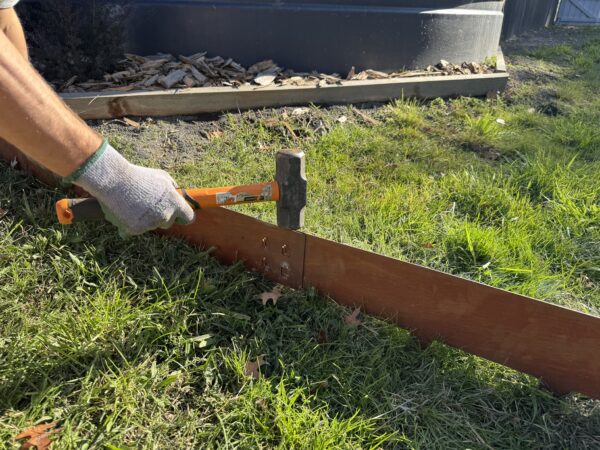
Corten edging is built for DIY, and most people get it in without any special tools. Each piece has integrated spikes and interlocks with the next, so there are no separate pins, pegs or joiners to line up.
The basic method is simple. Mark your line, then position each piece and push or gently tap the spikes into the ground. Aim to seat it into compacted soil rather than loose ground so it holds firm, and bury enough of the edge to create the underground barrier you want. To follow a curve, bend the steel by hand to the shape you need before you drive it in.
If you would like the full step by step, our guide to installing garden edging like a pro walks through it, and if you would rather not do the lifting, we also offer a supply and install service across Melbourne.
Is corten steel edging right for your garden?
Corten suits gardens where you want the border to feel like part of the landscape rather than stand apart from it. It works beautifully with native plantings, gravel and stone features, timber, and informal or rustic designs, where the warm rust tone settles into the surroundings. It also makes a striking contrast against green lawn and modern homes if you want the edge to be a feature.
If you prefer a sharp, uniform finish for a contemporary garden, a black powder-coated edge might suit you better, and you can weigh both up on our garden edging range. But if the natural, weathered look is what you are after, corten steel edging is one of the easiest ways to get it.
Ready to choose? Browse our corten steel edging range, or call our Melbourne team on 03 9386 0491 for a hand working out sizes and quantities.
Frequently asked questions
How long does corten steel edging take to rust fully?
Under normal outdoor conditions, the patina takes around 18 to 36 months to fully develop, moving from bright orange to a settled darker brown (Total Materia). It forms faster in wetter, more exposed spots. Because our corten edging is pre-rusted in the warehouse, it already has that weathered look when it arrives rather than starting out grey.
Will corten edging keep rusting until it wears through?
No. Unlike ordinary steel, corten forms a stable patina that seals the surface and slows further corrosion right down, so it does not keep eating into the metal (Wikipedia). The rust layer becomes a tight oxide film that is self-protecting and regenerates when exposed to the weather (Total Materia).
Does corten steel edging need any maintenance?
Very little. Once the patina has formed it protects itself, so there is no painting, sealing or coating needed (Wikipedia). It is worth checking now and then that each section is still seated firmly and re-seating any piece that shifts over time.
What gauge of corten edging is best for curves?
Our Landscape Edge Cor-Ten is a rigid 2.0 mm gauge and still bends by hand to follow curves and circular beds. For very tight radii, use a garden hose or string to lay out the shape and bend each piece to match before you drive it in. The heavier gauge also holds a firm, straight line for longer straight runs and larger projects.
Does corten steel edging work in coastal gardens?
It can, but salt air slows the patina down, so a seaside garden may take longer to reach that settled brown finish than an inland one (Total Materia). If you are gardening near the coast, our Melbourne team is happy to talk through whether corten or a coated option suits your spot better.